
There are plenty of bursaries that South African students who want to study at private colleges(not universities or TVET colleges) in 2026, can apply for. Private colleges in South Africa are gaining ongoing momentum simply because universities do not have space anymore. They get full so quick before you can even hit “Submit” on your application. Remember that guy who got accepted by UCT in the dream he had while sleeping on the queue? Well, that is funny but true.
Just think about it, last year alone, over 300 000 learners passed Matric with a Bachelor's pass. Now match that with the fact that South Africa has only 26 public universities, with a combined capacity of around 200 000 first-year spaces. The maths is not mathing.
Private colleges are a great alternative to study at in 2026, more especially considering that there are plenty of bursaries available to fund students who have applied to study at private colleges in South Africa. Remember, studying at private college is not cheap, and NSFAS does not fund them at all. So, if you cannot afford the study fees at private colleges, you need to find yourself a bursary that funds courses offered at private colleges in South Africa.
The bursaries covered on this page are those which are mostly suited for private college students in South Africa.
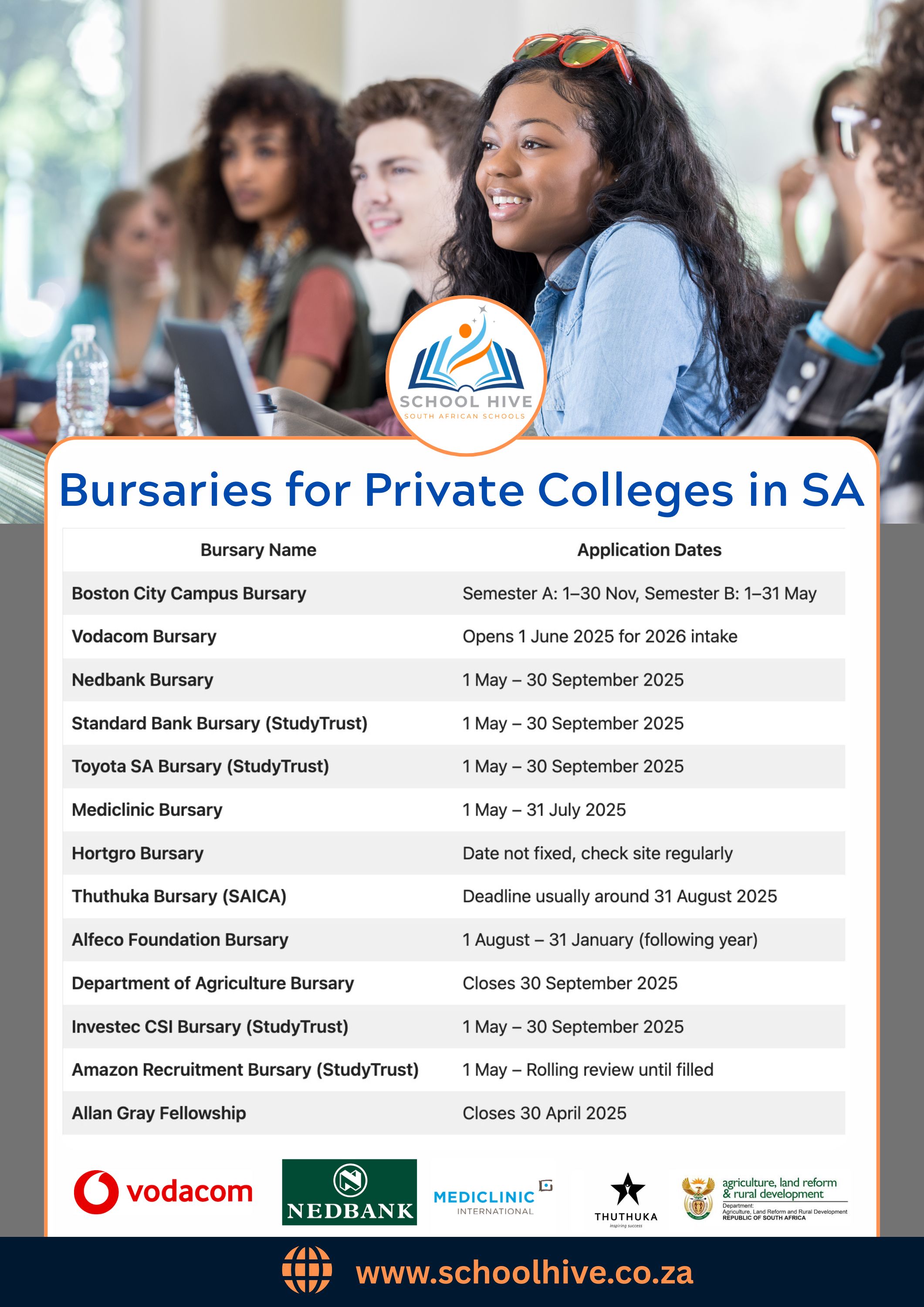
| Bursary Name | Application Dates |
|---|---|
| Boston City Campus Bursary | Semester A: 1–30 Nov, Semester B: 1–31 May |
| Vodacom Bursary | Opens 1 June 2025 for 2026 intake |
| Nedbank Bursary | 1 May – 30 September 2025 |
| Standard Bank Bursary (StudyTrust) | 1 May – 30 September 2025 |
| Toyota SA Bursary (StudyTrust) | 1 May – 30 September 2025 |
| Mediclinic Bursary | 1 May – 31 July 2025 |
| Hortgro Bursary | Date not fixed, check site regularly |
| Thuthuka Bursary (SAICA) | Deadline usually around 31 August 2025 |
| Alfeco Foundation Bursary | 1 August – 31 January (following year) |
| Department of Agriculture Bursary | Closes 30 September 2025 |
| Investec CSI Bursary (StudyTrust) | 1 May – 30 September 2025 |
| Amazon Recruitment Bursary (StudyTrust) | 1 May – Rolling review until filled |
| Allan Gray Fellowship | Closes 30 April 2025 |
Based on the requirements of these 2026 private college bursaries, to qualify, you should have the following 6 things in place:
- You must be a South African citizen with a valid ID
- You must be accepted or applying at a registered and accredited private college
- You must have good academic results (normally around 60% or higher)
- You must prove financial need (unless it is a merit bursary)
- You must provide your latest results, ID copy, and a strong motivation letter
- You must meet the field of study criteria (e.g. Accounting, Engineering, IT, etc.)
In the following sections, we will discuss each bursary and its suitability for private college studies, as well as how to apply for it. I have also clearly pointed out whether it allows private college students or not, so you do not waste time applying for something that will reject you just because of where you chose to study.
List of 2026 Bursaries that Fund Private College Students
Bellow are all the bursaries available for private colleges students for 2026:
1. Boston City Campus Bursary Programme
If you want to study at a private college, this bursary was made for you. Boston City Campus offers its own bursary programme for both new and current students. These bursaries are awarded to deserving students who need financial support to start, continue, or complete their Boston qualification.
What the bursary covers:
- Registration and tuition assistance (excluding external exam fees, transport, accommodation, and stationery)
- Available for Semester A (apply between 1–30 November) and Semester B (apply between 1–31 May)
Who should apply:
- Any student accepted to study at Boston City Campus
- Must submit a strong motivation letter and latest results
- Must apply at the support centre where you want to register
Why it works for private college students:
Because it is a Boston-run bursary, it is guaranteed to be used directly for your Boston course fees. It is not transferable and cannot be redeemed for cash, making it ideal for Boston students who need help funding their studies.
Apply through your local Boston City Campus centre
2. Vodacom Bursary Programme
Vodacom’s bursary programme supports full-time students who want to study towards careers in STEM (Science, Technology, Engineering, and Maths). Although public universities are often the first choice, this bursary can also be used at private colleges if they are accredited and offer full-time STEM qualifications.
What the bursary covers:
- Full tuition and registration
- Accommodation (or capped amount for private housing)
- Meals, textbooks, and a laptop
- Orientation and vacation work opportunities
- Cellphone and work-readiness training
Who should apply:
- First, second or third-year students
- Studying or planning to study full-time at an accredited South African tertiary institution (private or public)
- Must have passed Grade 12 with at least 70% average (or 65%+ if already in tertiary)
- Must be a South African citizen
Why it works for private college students:
If your private college is fully accredited and offers degrees or diplomas in STEM-related fields, this bursary can cover your studies. This includes private institutions offering IT, Data Science, Engineering, and Technology qualifications.
More info at Vodacom Bursary Portal
3. Nedbank External Bursary Programme
Nedbank’s bursary focuses on students with strong academic records who want to pursue careers in STEM or Green Economy fields. While many applicants choose public universities, this bursary also funds qualifying students accepted at private colleges, as long as they are registered as public tertiary institutions or universities of technology.
Note: Some private colleges, like Boston and Richfield, offer SAQA-registered qualifications that are recognised by banks and corporates like Nedbank.
What the bursary covers:
- Full tuition
- Registration fees
- Living allowance and learning materials
Who should apply:
- Students with an average of 65% or higher
- Must prove financial need
- Studying towards a first undergraduate or Honours degree
- Must be accepted at a recognised institution
Why it works for private college students:
If your private college is registered with the Department of Higher Education and Training (DHET) and provides accredited qualifications aligned to green economy or STEM, this bursary can be applied toward your studies.
Apply via Nedbank Bursary Page
4. Standard Bank Group Bursary (via StudyTrust)
Standard Bank’s bursary is designed to help academically strong students cover their full education journey, from undergrad to postgrad. Although public universities are the primary focus, many students at accredited private colleges have also benefited, especially in fields like Accounting, Data Science, IT, and Analytics.
What the bursary covers:
- Full tuition and textbooks
- Laptop and living allowance
- Mentoring, medical aid, and psychological support
Who should apply:
- South African citizens with 65%+ average
- Must be enrolled full-time in relevant fields
- Fields funded include Accounting, Actuarial Science, Commerce, Engineering, IT, Data Science
Why it works for private college students:
Private colleges offering SAICA-endorsed or DHET-recognised qualifications in Accounting, IT, or Finance qualify. For example, the Bachelor of Accounting at Boston City Campus is fully recognised and aligned to the requirements of SAICA.
5. Toyota South Africa Motors Bursary (via StudyTrust)
This bursary supports students pursuing degrees in Commerce, Law, Science, Engineering, and IT. While it is typically aimed at public university students, if your private college offers an accredited degree in one of the funded fields, you can still apply.
What the bursary covers:
- Full tuition and registration
- Vacation work
- Eligibility for Toyota Graduate Programme
Who should apply:
- SA citizens with 65% average and above
- Strong performance in Matric (especially Maths and English)
- Currently studying or accepted in one of the listed fields
Why it works for private college students:
Some private colleges now offer degrees that are recognised by employers like Toyota, such as Boston’s Business Science Analytics and IT programmes. If your qualification meets the criteria, you can qualify for this bursary.

6. Mediclinic Bursary Programme
If you are looking to study Nursing, Pharmacy, or Emergency Medical Care at a private institution, Mediclinic’s bursary programme is one of the best options available in South Africa. Many private health colleges (like Netcare Education, Mediclinic Learning Centre, and others) fall under accredited training institutions, and this bursary supports those studies.
What the bursary covers:
- Full or partial course fees
- For first-time students and current students in later years
- Support based on academic performance and financial need
Who should apply:
- Must have strong Grade 11/12 results or current tertiary marks
- Must be accepted/registered at an accredited institution offering one of the three courses
- Preference is given to Employment Equity candidates and applicants with financial need
Why it works for private college students:
Most private health institutions like Mediclinic Learning Centre are not public universities, but they are fully accredited. If you have been accepted at one of these institutions, this bursary can help you cover your study costs.
Apply on Mediclinic’s Careers Page
7. Hortgro Bursary Programme
The Hortgro Bursary supports students pursuing careers in Agricultural Sciences, Horticulture, and Environmental Sustainability. While many recipients go to universities like Stellenbosch or CPUT, this bursary also supports students enrolled in private colleges that offer registered agricultural or environmental programmes.
What the bursary covers:
- Full or partial tuition
- Monthly stipend
- Access to internships, mentorships, and industry connections
Who should apply:
- Students in undergraduate or postgraduate studies
- Studying in agricultural fields aligned with the deciduous fruit industry
- Must be at a recognised and registered institution
Why it works for private college students:
If you are studying Agricultural Management, Environmental Practice, or Horticulture at a private college like AGRICOLLEGE International or other DHET-registered institutions, this bursary is open to you.
Apply at Hortgro’s Official Page
8. Thuthuka Bursary (via SAICA)
Although traditionally geared towards public universities, the Thuthuka Bursary is ideal for students enrolling in SAICA-accredited private colleges, such as Boston City Campus. Their Bachelor of Accounting degree is endorsed by SAICA and leads directly into the Chartered Accountant (CA) qualification pathway.
What the bursary covers:
- Full tuition, books, meals, accommodation
- Academic support, life skills, and mentoring
- Dedicated programme manager and workplace exposure
Who should apply:
- Black African or Coloured students with strong Matric marks
- Must be studying (or planning to study) BCom Accounting CA stream
- Household income must be under R350 000 per annum
- Must write the NBTs before the end of August
Why it works for private college students
SAICA recognises private institutions like Boston for their accredited Bachelor of Accounting programme. If you apply at such a college, you qualify for Thuthuka funding.
9. The Youth CSI Bursary Partnerships (via Boston)
Boston City Campus has partnered with several non-profit and corporate CSI initiatives that provide bursary funding to young people from disadvantaged communities. These are not standard government bursaries, but rather partnerships between Boston and organisations that fund tuition directly at private colleges.
Some CSI partners include:
- Afrika Tikkun
- Caster Semenya Foundation
- Aspire Youth
- Good Governance Africa
- Youth Community Action Programme
What the bursaries cover:
- Full or partial tuition at Boston City Campus
- Some bursaries may include stationery, mentorship, and support networks
Who should apply:
- South African youth aged 17+
- Must apply through Boston's support centres or through the partner organisations
- Must show financial need and academic motivation
Why it works for private college students:
These CSI bursaries are exclusive to Boston and directly support your education at a private college — no conversion or external approval needed.
Learn more about Boston bursary partnerships
10. Alfeco Foundation Bursary Programme
The Alfeco Foundation Bursary supports students who want to further their studies in fields such as Engineering, Finance, Marketing, and more. Although it is open to all registered institutions, students attending accredited private colleges are also eligible, as long as they meet the bursary’s academic and motivation criteria.
What the bursary covers:
- Tuition and academic-related expenses for one academic year
- Fields funded include Engineering, Finance, and Business fields
Who should apply:
- Students from financially needy backgrounds
- Must provide academic results, ID, proof of registration, and a motivation letter
- Open to students studying at any recognised institution, including private colleges
Why it works for private college students:
The bursary does not limit applications to public universities only. If your private college is fully registered with the Department of Higher Education and Training (DHET) and your field of study aligns with Alfeco’s focus areas, you can apply.
Apply on Alfeco Foundation Website
11. Department of Agriculture Bursary (DoA)
The Department of Agriculture (DoA) funds students in agricultural and environmental science-related qualifications, including BSc Agric, BSc Food Science, Soil Science, Viticulture, and more. Although the focus is mostly on public universities, some accredited private colleges also offer diplomas in agriculture and food technology, making them eligible under the bursary’s terms.
What the bursary covers:
- Full tuition, meals, accommodation, monthly allowance, and study materials
- Covers qualifications such as Diploma in Food Technology, Advanced Diplomas, and BSc Agric-related degrees
Who should apply:
- South African citizens from poor or rural backgrounds
- Students who meet subject requirements (50%+ in Maths and Science depending on qualification)
- Students registered or planning to register for a qualification on the approved list
Why it works for private college students:
Some private colleges like AGRICOLLEGE International, or those offering Diplomas in Food Technology, are eligible, provided the qualification is accredited and aligned to the agriculture sector. Students at such colleges are encouraged to apply.
More info and application form at www.nda.gov.za
12. Investec CSI Bursary
The Investec CSI Bursary is one of the most prestigious in the country, aimed at high-performing students who want to study degrees related to finance, law, IT, engineering, or medicine. However, it is strictly limited to public universities only.
Important Note:
This bursary does not fund private college students under any condition. If you are planning to study at a private institution, this bursary is not for you.
Read more on the Investec Bursary Page
13. Amazon Recruitment Bursary (for Software Engineering)
This bursary is designed for students in their final or penultimate year of a software development degree. It funds the full cost of studying Computer Science, Software Engineering, or Artificial Intelligence. The bursary includes an internship at Amazon and a guaranteed opportunity to be assessed for full-time employment.
What the bursary covers:
- Tuition, accommodation, subsistence, transport, books, and laptop
- A paid internship at Amazon during vacation
Who should apply:
- Final year or third-year undergraduates entering Honours in 2026/2027
- Students from previously disadvantaged backgrounds
- Must be studying at a South African university
- Average of at least 65%
Why it works (or does not) for private college students:
This bursary requires you to be registered at a recognised South African university, meaning it does not currently include private colleges unless the private institution is formally recognised as a university (which most are not). If you are at a registered university that runs privately, double-check your institution’s status before applying.
Apply via StudyTrust for Amazon Bursary
Alright, if you have made it this far, then you already know that there are real bursaries out there that actually fund students who choose to study at private colleges in South Africa that can help you cover your tuition, textbooks, accommodation, and in some cases, even meals and laptops.
The earlier you apply, the better your chances. Some bursary programmes open as early as 1 May every year and close around 30 September. Others, like the Alfeco Bursary, stay open from August to January, while the Allan Gray Fellowship closes 30 April sharp.
So here is your plan:
- Pick a private college that is registered and accredited.
- Find out which bursaries on this page apply to your field of study.
- Prepare your documents: certified ID, latest results, proof of registration, and motivation letter.
- Submit before the deadline. If it says 30 September, do not wait for 29 September to start.
Also, do not limit yourself to just one bursary. Apply for all the ones you qualify for.