
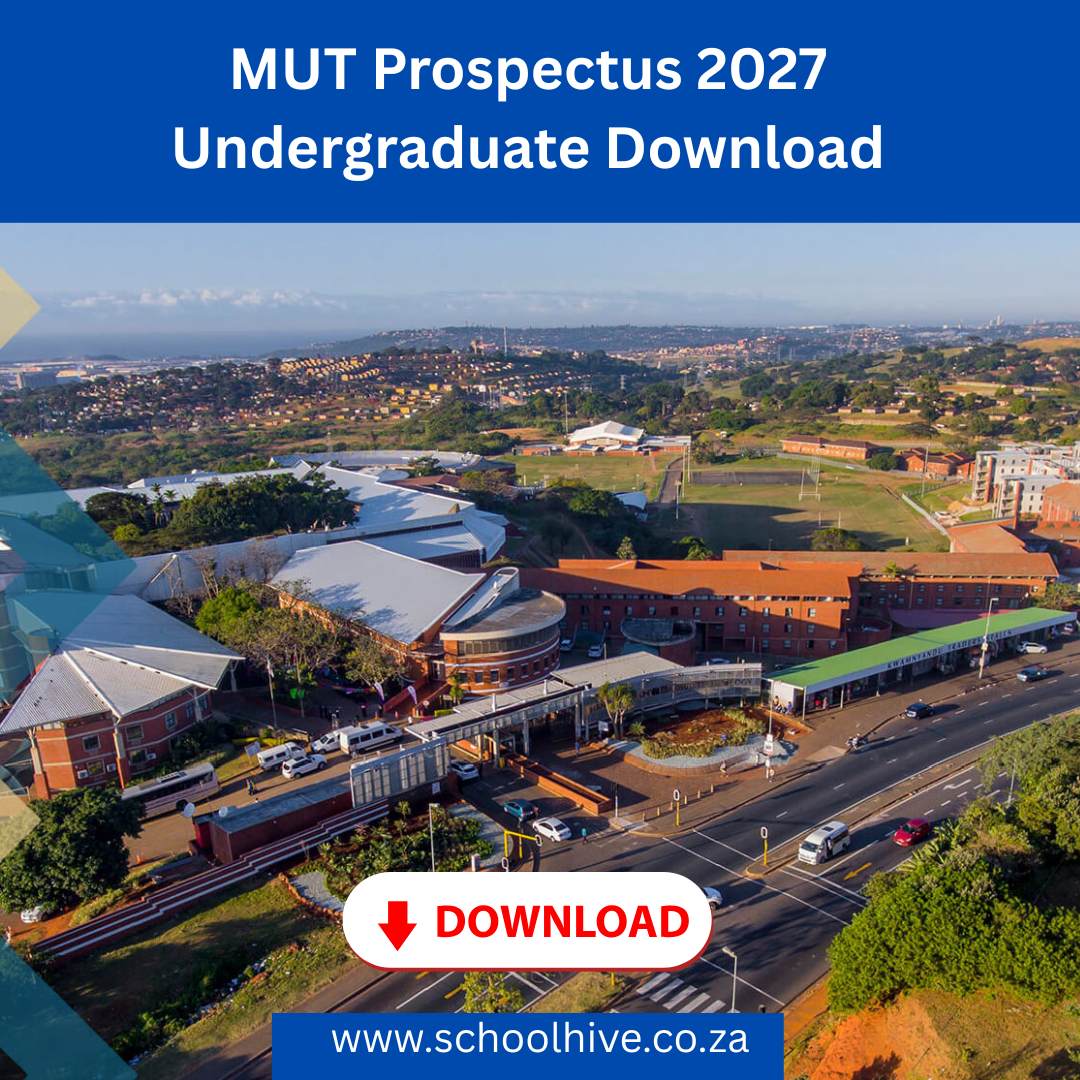
On this page, you will find the 2027 Prospectus for Mangosuthu University of Technology (MUT). The full pdf is downloadable on the page. We have also embedded the entire prospectus document on the page in a viewable format.
MUT Prospectus 2027
Document Transcript (Click to expand) View Text
UNDERGRADUATE PROSPECTUS shape and own the futureshape and own the futureTABLE OF CONTENTS Foreword Message from the Vice-Chancellor and Principal Diversity at MUT MUT - My first choice! How to apply to MUT MUT libraries MUT qualifications Faculty of Engineering Faculty of Management Sciences Faculty of Natural Sciences Campus life Closing statement 4 6 8 12 14 16 17 18 22 26 30 35FOREWORD Mangosuthu University of Technology (MUT) is uniquely located in a semi-urban setting at the heart of Umlazi Township, the fourth largest township in South Africa. If you are interested in engineering, natural sciences, or management sciences, MUT has a place for you. Regardless of who you are, where you come from, or where you want to go from here, as an MUT student you will be valued as an important part of our family. Our two campuses are on the public transport access route that can be reached through buses, taxis and trains. We strive to offer students an unforgettable campus life by providing valuable academic programming, academic support services to enhance students’ progress, leadership and entrepreneurial development programmes, an active sports culture, and a sense of community service. Our students and academic staff represent a diverse group of South Africans and Africans from across the continent and outside the African borders. MUT identifies teaching and learning as its core business and therefore seeks to excel in academic learning and achievement. 4We are a diverse institution anchored in our communities and driven by our strategy statement which is: SHAPE AND OWN THE FUTURE. MUT is a research-informed University of Technology with a work-integrated curriculum which seeks to provide experiential learning and exposure to professional practice. 5MESSAGE FROM THE VICECHANCELLOR AND PRINCIPAL I start on a positive note by wishing you success as you plan the next chapter in your life; becoming a University student. There is a reason for this. Life is about planning and ‘failing to plan’ as they say is ‘planning to fail’. Have a plan and you will succeed. 6You are applying to join MUT during the most exciting period where we are focused on the MUT Strategy 2020-2025. But what does MUT Strategy 2025 mean to you? As a University we want all of you to ensure that you “Shape and Own the Future”. This is our strategy statement or tagline. You will need to apply this tagline to everything you do as an MUT student. Keep on asking yourselves if you are shaping and owning your future? Our Strategy Statement: “Shape and Own the Future” has the following pillars. Firstly, we seek: • To make your education relevant to the Fourth Industrial Revolution by providing you with knowledge and qualifications to meet the demands of the 4IR; • To advance you with knowledge and understanding of our communities. As students in an urban area, it is important that you understand the plight of our communities and see how your education could advance our disadvantaged communities; • To offer you with a decolonised curriculum that inspires a truly African identity; • To create an awareness among yourselves about the importance of institutional values. Our values are Accountability. Integrity. Respect. Excellence. Without practising these values and embedding them as part of your day to day activities, you may not progress in life. You are here to change your life and the lives of your family, our country and the world at large. Think big. Don’t limit yourselves to KZN - the world is waiting for you to come with some big discoveries. May the Lord walk with you and protect you during your time with us. Be streetwise and know what Gender-Based-Violence means and what to do about it. Always apply the golden principle among your fellow students: “Do unto others as you would have done unto you”. Stay blessed and successful until you graduate from MUT. Dr Enoch Duma Malaza Vice-Chancellor and Principal 7DIVERSITY AT MUT Diversity is about more than what you look like or where you come from - it is about your choices and experiences. MUT is home to people from an abundance of ethnic and socio-economic backgrounds. At MUT you will have choices and experiences that will make you a more diverse person. The stance of the MUT leadership against sexual and GenderBased-Violence and xenophobia within the University is unequivocal. Gender-Based Violence and xenophobic attacks are not acceptable at MUT. 8 9Our vision To be a transforming, equitable, sustainable and academically excellent University of Technology anchored in its communities. Our mission To offer technological, career-directed educational programmes focusing on innovative problem-solving research and engage with government/business/industry and communities as end-users. Our values Accountability Integrity Respect Excellence 10 11MUT — MY FIRST CHOICE! Each year, thousands of students ask us why they should apply on time and make MUT their first choice. Here are some of the reasons. • Making MUT your first choice is the ultimate way to demonstrate your interest in MUT. An opportunity for you to differentiate yourself from the rest of the crowd. • Competition is keen. Each year MUT receives over 40 000 applications. Putting us first gives your application a better chance for consideration. • If you meet qualification requirements, your application will be given immediate attention. You could be one of the first among your classmates to own an MUT student card! FINANCIAL MATTERS Did you know you can afford to study at MUT? Providing access to academically excelling students is our main objective, and we believe your financial circumstances should never stand in the way. That is why MUT offers the most competitive tuition fee structure, ranging between R4 530 and R15 350 per semester depending on the course and subjects. Residence fees range between R4 120 and R11 150 per semester. Our financial aid resources and policies ensure that MUT is affordable for all prospective students. NOTE: Travel expenses, meals, stationery and text books are not included in the tuition and residence costs. AWARDS FOR ACADEMIC EXCELLENCE MUT offers Matric Aggregate Awards to first year students who achieved level 7 on any of their grade 12 subjects with the exception of Life Orientation which is considered to be a non-curriculum subject. The award may be used to finance your first year studies at MUT. This award is administered by the Financial Aid office. 12NATIONAL STUDENT FINANCIAL AID SCHEME (NSFAS) The scheme was established by the government to provide financial support to disadvantaged students who wish to further their studies at public higher education institutions. NSFAS offers subsidised free higher education and training to academically deserving underprivileged and working class South Africans. Applications for NSFAS funding are submitted online at www.nsfas.org.za. 13 500 13 500 13 500 13 500 13 500 13 500 13 500 13 500 13 500 Total enrolment MUT students awarded financial aid Student clubs & societies MUT students on scholarships and bursaries Sport codes Applications received from prospective students Student body composition Religious groups Beds are reserved for first year students on campus residences 13 500 26 710 9 718 16 > 40 000 49,1%F 50,9%M 10 1 680 13HOW TO APPLY TO MUT All first year applications to study at MUT are submitted through the Central Applications Office (CAO). This is a simplified way of applying for more than one programme, using one application form, and paying a single application fee. Apply online at www.cao.ac.za or by downloading an application form. CHECKING THE PROGRESS OF YOUR APPLICATION You can track the progress of your application by going to www.cao.ac.za and entering your CAO number, sending an email to enqgeneralcao@cao.ac.za or call 031 268 4444. CLOSING DATES FOR APPLICATIONS Faculty of Engineering 1st semester 2nd semester Faculty of Natural Sciences Faculty of Management Sciences 30 Sept 31 May 30 Sept 30 Sept Applications submitted after 30 September accumulate a late application fee determined by the CAO. APPLICATION DOCUMENTS For South African applicants • Grade 11 final results, grade 12 June exam results, National Senior Certificate or Statement of Results • Identity document • Students transferring from other universities should submit an academic record and a certificate of good conduct Non-South African applicants • Valid passport • Valid proof of medical insurance cover • Police clearance certificate • SGCE, GCE, GCSE, IGCSE or Cambridge School Certificate 14GENERAL ADMISSION REQUIREMENTS Each faculty stipulates admission requirements based on points aggregate calculated from the best six subjects presented by the prospective student. Over and above the points system, some departments administer a compulsory entrance test. MINIMUM ENTRANCE REQUIREMENTS • National Senior Certificate with a diploma pass or N3 with 50% pass in Mathematics and English • A minimum of 6 subjects with level 4 pass for diploma study and level 3 for Access Courses • English Home Language or First Additional language, level 4 pass • Specific subject combination and pass level relevant to the qualification; and • Minimum points as per faculty requirement and as listed in the CAO handbook ADMISSION POINTS CALCULATION GUIDE National Senior Certificate NSC Level Rating 7 6 5 NSC % Points 90 – 100 8 80 – 89 70 – 79 60 – 69 4 3 50 – 59 40 – 49 7 6 5 4 3 Senior Certificate Symbol A B C D Points Higher Grade 8 7 6 5 Standard Grade 6 5 4 3 E 4 2 15 16MUT offers diplomas and degrees at undergraduate level that are accredited by professional bodies and are internationally recognised. As a UoT, MUT enables students to experience the world of work through a formalised WorkIntegrated-Learning (WIL) programme. We allow students to achieve their dreams in engineering with a minimum pass of 50% in Maths and Science. MUT QUALIFICATIONS 17FACULTY OF ENGINEERING The Faculty of Engineering at MUT has graduated thousands of professionals since the first MUT graduation in 1986. Regardless of which programme you choose within the faculty, MUT will lay a strong foundation for your career to enable you to transform lives. Pursuing your engineering qualification, you will be required to move beyond the classroom and get hands-on training in the field through Work Integrated Learning (WIL). Engineering programmes are about the design and production of useful products and services. Engineers convert scientific knowledge into technology and then technology into successful advancement. At MUT we offer Diplomas in Chemical, Civil, Surveying, Electrical, Building, and Mechanical Engineering. MINIMUM SUBJECTS REQUIRED English | Maths | Physical Science All at 50% and above Further departmental screening processes QUALIFICATIONS AND CAO CODES FOR THE FACULTY OF ENGINEERING 18Qualification Minimum requirements CAO code Duration Diploma: Chemical Engineering Mathematics 4 Physical Science 4 English 1st Additional 4 MN-M-CE3 3 yrs Diploma: Civil Engineering Mathematics 4 Physical Science 4 English 1st Additional 4 MN-M-CV3 3 yrs Diploma: Surveying Mathematics 4 Physical Science 4 English 1st Additional 4 MN-M-SV3 3 yrs Diploma: Building Mathematics 4 Physical Science 4 English 1st Additional 4 MN-M-BU3 3 yrs Diploma: Electrical Engineering Mathematics 4 Physical Science 4 English 1st Additional 4 MN-M-EE5 3 yrs Diploma: Mechanical Engineering Mathematics 4 Physical Science 4 English 1st Additional 4 Eng Graph & Design 4 MN-M-ME3 3 yrs 19Qualification Minimum requirements 21,667 mm Duration Chemical Engineering English HL4 /FAL 3 Mathematics 3 Physical Science 3 MN-M-CEB 6 mths Civil Engineering English HL4 / FAL 3 Mathematics 3 Physical Science 3 MN-M-CVB 6 mths Electrical Engineering English HL 4 / FAL 3 Mathematics 3 Physical Science 3 MN-M-EEB 6 mths Mechanical Engineering English HL4 / FAL 3 Mathematics 3 Physical Science 3 MN-M-MEB 6 mths Building English HL4 / FAL 3 Mathematics 3 Physical Science 3 MN-M-BUB 6 mths Surveying English HL4 / FAL 3 Mathematics 3 Physical Science 3 MN-M-SVB 6 mths The Faculty of Engineering also offers bridging programmes designed to prepare students who could not fulfill all the diploma entrance requirements. ENGINEERING BRIDGING PROGRAMMES AND CAO CODES LIST OF ENGINEERING QUALIFICATIONS AND CAREER OPPORTUNITIES Diploma: Chemical Engineering Chemical engineering uses principles of chemistry, physics, mathematics, biology, and economics to produce, transform and transport chemicals, minerals and energy. A chemical engineer designs large-scale processes that convert chemicals, raw materials, living cells, microorganisms, and energy into useful products. The course trains students to be technicians qualified to assist a chemical engineer or plant operator in the control, maintenance and functioning of processes involved in the production of chemicals. The technician’s duties include research, economic evaluation and unit operations. 20Diploma: Civil Engineering Civil engineering is a professional engineering discipline that deals with the design, construction, and maintenance of the built environment, including public works such as roads, bridges, canals, dams, airports, harbours, sewerage systems, pipelines, structural component of buildings and railways. The course qualifies the technician for employment with civil engineering contractors, consultants, government departments or municipalities, where he/ she would form part of a team usually managed by a professional engineer or technologist. The technician could be involved in the design and construction of civil engineering structures such as roads, bridges, dams, railways, harbours, buildings and airports. Diploma: Surveying Scaled base maps are essential to any construction planning or development of land. The course qualifies the student as a surveyor who has the ability to prepare maps of various scales set out for the required structures, transportation routes, industrial and residential properties. Diploma: Construction Management & Quantity Surveying (Building) Construction management is concerned with organising, scheduling, mobilising and directing equipment, material and personnel in performance of a construction contract. A quantity surveyor is responsible for estimating the amount and cost of materials and labour needed for building and how long it will take to complete a building project. After completing the course students specialise in either construction management or quantity surveying. The course provides essential skills and knowledge needed in the construction of housing, schools, community facilities and other building projects. Diploma: Electrical Engineering Electrical engineering is the branch of engineering that deals with the technology of electricity. Electrical engineers work on a wide range of components, devices and systems, from tiny microchips to huge power station generators. The course equips students with the knowledge and skills needed for working in electrical power generation and distribution environments, process control environments and electronic communication environments. The course may include design, development and work on computer-based systems. Diploma: Mechanical Engineering This branch of engineering is concerned with machinery and mechanical power. It encompasses the design, production, and use of machines and tools. The diploma qualifies students for a wide range of occupations. There are employment opportunities in the manufacturing industry, motor industry, ship building industry, aircraft industry, power stations and on the mines. 21FACULTY OF MANAGEMENT SCIENCES Management sciences is an interdisciplinary faculty encompassing the study of problem solving and decision making, providing skills and knowledge around the management of organisations and learning opportunities for aspiring managers and leaders. Management sciences is concerned with developing and applying models and concepts that help to tackle management issues and solve managerial problems. The faculty offers Diplomas in Accounting, Cost and Management Accounting, Public Finance & Accounting, Human Resource Management, Marketing, Office Management & Technology, and Public Management. MINIMUM SUBJECTS REQUIRED English | Maths | Accounting All at 50% and above Further departmental screening processes 22QUALIFICATIONS AND CAO CODES FOR THE FACULTY OF MANAGEMENT SCIENCES Qualification Minimum requirements CAO code Duration Diploma: Accounting English Home Language 4 English First Additional Language 5, Accounting 4 Mathematics 3 OR Mathematics Literacy 6 MN-M-AC3 3yrs or 4yrs Diploma: Finance & Accounting: Public English Home Language 4 English First Additional Language 5 Accounting 4 Mathematics 3 OR Mathematics Literacy 6 MN-M-PF3 4 yrs Diploma: Human Resource Management English Home Language 3 English First Additional Language 4 Accounting Mathematics 3 OR Mathematics Literacy 4 MN-M-HR3 3yrs Diploma: Marketing English Home Language 4 English First Additional Language 5 Mathematics 3 OR Mathematics Literacy 4 Accounting 3 MN-M-MM3 3yrs Diploma: Office Management & Technology English Home Language 3 English First Additional Language 4 Any other 5 accredited subjects 25 points A pass in typing or Computer Studies will be an added advantage MN-M-OT3 3yrs Diploma: Public Management English Home Language English First Additional Language 4 Any other 5 accredited subjects 25 points MN-M-PU3 3yrs 23CAREER OPPORTUNITIES Diploma: Accounting, Cost & Management Accounting Cost accounting is part of management accounting which establishes budgets, standard costs and actual costs of operations, processes departments or products in an organisation or enterprise. Cost accounting includes the analysis of variances, profitability or social use of funds. Costing data provided by the cost accountant serves as a managerial tool for planning, controlling and decision-making. The diploma is geared to provide students with a thorough understanding of the principles, techniques, methods and practice of cost accountancy, as well as the use of cost information for planning, control and decision- making. Cost information is used for the preparation of reports required by management for such purposes as the formulation of policies, planning and controlling activities, decision-making, disclosure of information to external entities and employees. Diploma: Human Resources Management This course covers all the necessary activities involved in the provision and maintenance of human resources within an organisation. This includes recruitment, payroll management, human resource development and organisational development, to name a few. Graduating students will have the requisite knowledge to easily join organisations as Skills Development Facilitators (SDFs) Employee Assistance Plan Managers (EAPs) or many other human resource management positions. The human resources practitioner or manager has an important role to play in ensuring that an organisation has a suitably skilled and efficient work force. The diploma qualifies students for a range of HR occupations in the areas of recruitment, employee benefits, talent development & management. Diploma: Marketing Marketing involves researching consumer needs and formulating means to promote and supply products and services to meet those needs efficiently and effectively. The diploma qualifies students for a wide range of occupations in the areas of marketing, advertising and public relations. 24Diploma: Office Management & Technology This programme provides students with professional administrative and communication skills. It is intended for those students wishing to become administrative assistants, secretaries, personal assistants or office professionals at an intermediate level in any sector of the economy. At the end of the programme, students will be able to provide independent and competent management support, enabling them to plan and execute tasks creatively, professionally and efficiently. The course gives students the business and administrative skills and knowledge to understand how a business operates and to administer an office efficiently. Diploma: Public Management This programme equips students with the theory and practical skills needed to administer and manage the provision of government services effectively and efficiently. The government provides many essential services to communities in South Africa, including housing, education, transport and the provision of municipal services through local government. A huge administrative infrastructure employing thousands of public servants organises the delivery of these services through the various government departments. 25FACULTY OF NATURAL SCIENCES Natural science is about studying anything that involves subjects such as physics, chemistry and biology. Those subjects are a discipline in studying the physical and natural world or the events that happen in nature. The Faculty of Natural Sciences offers a BSc in Environmental Health and National Diplomas in Agriculture, Biomedical Sciences, Analytical Chemistry, Community Extension, Information Technology and Nature Conservation respectively. MINIMUM SUBJECTS REQUIRED English | Maths | Physical Science | Agricultural Science | Life Sciences All at 50% and above Further departmental screening processes QUALIFICATIONS AND CAO CODES FOR THE FACULTY OF NATURAL SCIENCES Qualification BSc: Environmental Health Minimum requirements CAO code Duration Bachelor pass English Home Language or FAL 4 Mathematics 4 OR Mathematics Literacy 5 Physical Science 4 OR Life Science 4 (Geog and Agric Science 5 recommended) MN-M-BE4 4 yrs 26Bachelor of Health Science - Medical Laboratory Sciences (BHSc-MLS) Bachelor pass English Home Language level 4 Life Sciences level 4 Mathematics level 4 Physical Science level 4 MN-M-BLS 4 yrs Diploma: Agriculture Agricultural Science 4 OR Life Science 4 English Home Language 4 OR English First Additional Language 4 Mathematics 3 OR Mathematics Literacy 4 Physical Science 3 MN-M-AG3 3yrs Diploma: Biomedical Science English Home Language 4 English First Additional Language 4 Mathematics 4 Life Sciences 4 OR Physical Science 4 Compulsory entrance test MN-M-BD3 3yrs Diploma: Analytical Chemistry English Home Language 4 English First Additional Language 4 Mathematics 4 Physical Science 4 MN-M-AN3 3yrs Diploma: Community Extension English Home Language 4 And level 4 in one of these subjects; Agricultural Science, Consumer Studies, Life Science, Geography, Economics MN-M-CX3 3yrs Diploma: Nature Conservation English First Additional Language 4 Agricultural Science 4 OR Life Science 4 Mathematics 3 MN-M-NC3 3yrs Diploma: Information Technology English Home Language 3 English First Additional Language 3 Mathematics 3 OR Mathematics Literacy 4 Minimum of 23 points in 6 best subjects including Maths/Maths Literacy and English Selected candidates will be called for a compulsory entrance test. MN-M-IT3 3yrs or 4 yrs Access pgrm 27CAREER OPPORTUNITIES Bachelor of Health Science - Medical Laboratory Sciences (BHSc-MLS) The four-year programme includes clinical practice in an accredited training laboratory for the last 18 months of the programme. In the fourth year of study, learners need to select an area of specialisation in which they will practice from one of the following disciplines: Clinical Chemistry, Clinical Pathology, Cytogenetics, Cytopathology, Haematology, Histopathology, Immunohaematology, Immunology, Microbiology, Virology, Forensic Science and Pharmacology. BSc: Environmental Health Environmental health practitioners are trained to inform, assist, advise and interact with the population in the work place, homes, and public recreational areas to promote the health and safety of all members of the community. All students who take up the course will be registered with the Health Professions Council of South Africa (HPCSA) Job opportunities: Safety, Health, Environmental and Quality Management Officer; Waste Management Officer, Environmental Management Officer, Veterinary Public Health Officer, Meat Inspector, Occupational Safety Officer, Environmental Protection Officer Agriculture: Animal Production Students are equipped with theory in all aspects of animal production and practical application of animal production in industry and extension contexts. Agriculture: Students are prepared, theoretically and practically, for a career in the fields of agricultural development or extension and to promote the development of sound agricultural practice in the farming industry. Diploma: Biomedical Technology The course qualifies the biotechnologist for employment in a pathology laboratory. Alternate employment opportunities include positions in laboratories linked to the food or medical industries, or in sales divisions of medical equipment and pharmaceutical products industries. Diploma: Analytical Chemistry The course prepares technicians for positions in analytical laboratories, where many types of analysis are made, using a variety of techniques including classic wet chemical methods and sophisticated instrumental methods. Technicians may find work in routine analytical quality control laboratories or in research 28 laboratories which explore new processes and techniques of manufacture.Diploma: Information Technology The National Diploma in IT prepares students for the development and management of IT systems in a distributed environment. Current specialisation options are as follows. 1. Software Development: Students are empowered to design and produce software products and systems to meet specified needs so that they work reliably and their production and maintenance is cost-effective. Career paths: applications development, programming, systems development, systems analysis, database administration. 2. Communication Networks: Students are provided with the knowledge and skills to design, develop, implement and manage networks by integrating knowledge of modern network topologies and protocols to create an appropriate and adequate environment of communication and information sharing. Career paths: network design, network administration, network technologist, etc. Diploma: Nature Conservation To cater for the human resources needs of conservation organisations, and to initiate self-employment opportunities for students by providing theoretical and practical expertise in the field of conservation studies. This is a functional and well-recognised qualification, which is a prerequisite for appointment and promotion as a nature conservator. Diploma: Community Extension To train students to improve the standard of living of rural communities by: • Motivating communities to participate in self-help projects, particularly in order to promote food security and alleviating poverty; and • Effectively communicating improved functioning of rural and urban households by extending domestic, social and agricultural skills into the communities. 29CAMPUS LIFE Campus life forms a vital part of student experience and creates unique opportunities for friendships and learning. At MUT we aim to make your studies and social life as fulfilling and enjoyable as possible. Good physical and mental health is the result of a balanced life. We believe that students should aim for success by working hard in their studies, and taking time to make friends and develop interests outside the classroom. MUT offers a range of support services intended to give students a lifelong experience. 30Clubs and societies A range of active social and religious clubs are available for MUT students to explore their passions and contribute to the wellbeing of fellow students and future MUT students. These are the clubs and associations available and open to all students. MUT Choir / Mutisa (MUT International Students Association) / Swdo (Student Living With Disability) / Abasa / Acts / Ancyl / Ansoc / Bmf / Campus Impact / Acuso (Cultural Society) / Jazz And Fusion / Luso / Nsbe / Natesa / Performing Arts / Sadesmo / Sasco / Sco / Taccsso / Ycl / Atez / Methssoc/ Sdasm / Daso / Nasmo / Effsc 31Gymnasium The student gymnasium located in the main campus offers students free weightlifting, cardio equipment, organised sports, and indoor sports facilities. MUT Libraries The Library Services provide a wide range of instructional services to assist staff and students in the use of information sources and library facilities. MUT has two libraries - one in the main campus and another in the Faculty of Natural Sciences campus. Our libraries provide comprehensive access to a wide range of material across our faculties and disciplines. Student Health Services The Student Health Services afford students access to a fully equipped, on-campus clinic where you will be attended to by professional nurses and a part-time medical doctor from Monday to Thursday between 8am and 3pm, and between 8am and 12pm on Friday. First aid care and ambulance transportation to the nearest hospital is also provided to students after hours. 32Sporting Activities Mangosuthu University of Technology recognises the value and importance of participating in sporting activities and encourages its students to get involved in sports. The Sport Department is looking forward to welcoming new and returning students to a variety of sports, both competitive and recreational, so that students can excel not only academically, but also in other ways that will enhance their experience at MUT. Available sporting activities: Aerobics Athletics Darts Boxing Basketball Chess Cricket Dance Golf Karate Netball Rugby Tennis Table tennis Volleyball Scrabble Hockey Bodybuilding Indoor soccer Handball Softball Snooker Swimming Soccer 33MUT Student Accommodation and Residence Life There is a diverse range of housing options ran ging from traditional residence to apartments. MUT offers 1 680 beds to new students on the main campus. This means first year students are prioritised for accommodation on the on-campus residences. Living in one of MUT’s residences, you and your fellow classmates will share a range of experiences and aspirations. You will live in a diverse community of students and create lasting friendships. While each residence at MUT has unique features and amenities, all provide reasonable quality accommodation, facilities and resources. Both on-campus and off-campus student residences offer similar access and control systems, have established governance, a formal management structure as well as basic and reasonable accommodation that is conducive to living and learning. It is a home - a place where you can belong! 34CLOSING STATEMENT While studying at MUT, you will meet and get to know great people who will enrich your thinking and your career. MUT will give you an opportunity to explore, to collaborate and to challenge yourself. Please feel free to request a guided tour of our campuses by calling 031 907 7296 or 031 891 9323. 35CONTACTING MUT General enquiries: info@mut.ac.za Call centre: 031 819 9280 STUDENT RECRUITMENT OFFICE innocent@mut.ac.za ayandab@mut.ac.za 031 907 7296 / 031 819 9323 www.mut.ac.za @MutSchools @mut_schools
SECTION A / ISIGABA A
1.2.3 Texture
1.2.4 Drone
A. Consumer Protection Act, 2008 (Act 68 of 2008)
B. Vision
C. Marketing
D. Deposit slip
1.2.5: Promotes a fair, accessible, and sustainable marketplace...
1.2.6: Proof that a farmer receives when banking money...